
Few dishes say comfort quite like a lasagna: layers of pasta, meat sauce and béchamel, baked until the top turns golden. It's on the main menu at Fiena, our family-run Italian cafe, bar and restaurant at 4 Medway Court, Judd Street, London WC1H 9QX, near King's Cross St Pancras. Here's where it comes from and how we serve ours.
Lasagna or lasagne?
Strictly speaking, lasagna is a type of pasta: wide, flat sheets. The baked dish is made by stacking those sheets with fillings such as meat, cheese, vegetables and sauce, topping it with grated cheese and baking it in the oven (al forno). As for the spelling, both are right. In Italian, lasagne is the plural, and northern Italians tend to call the dish lasagne, while southern Italians tend to say lasagna. British English usually follows the north; our menu uses lasagna.
A very old dish
The name may go back to ancient Greece. One theory traces it to laganon, a flat sheet of dough cut into strips; another links it to lasanon, a Greek word for a cooking stand that the Romans borrowed as lasanum, a cooking pot. The dish itself is medieval. The oldest known written reference to lasagna is in a ballad written down by a notary in Bologna in 1282, and the first recorded recipe appears in the 14th-century Liber de Coquina (The Book of Cookery). It bore only a slight resemblance to today's dish, and there were no tomatoes yet: they only reached Europe after 1492.
Many regions, many lasagne
The version most people know outside Italy, layered with a thick ragù and béchamel, is traditionally linked with Emilia-Romagna and its capital, Bologna, where lasagne alla bolognese is made with ragù, béchamel and Parmesan. Other regions do it differently:
- Naples: lasagne di Carnevale, eaten at Carnival, is layered with sausage, small fried meatballs, hard-boiled eggs, ricotta and mozzarella in a Neapolitan ragù.
- Ferrara: green pasta sheets, coloured with spinach.
- Genoa: a light béchamel with pesto.
Wikipedia's lasagna page has more of the history.
Our lasagna
On our main menu, the Lasagna is described as layers of fresh pasta, slow-cooked beef ragù, creamy béchamel, mozzarella and parmesan. That's the ragù-and-béchamel style linked with Bologna, with mozzarella and parmesan added. It's served from midday until close every day.
Slow-cooked beef ragù also goes into our spaghetti bolognese. If you need to avoid gluten, ask for the bolognese with gluten-free penne, which is available for all of our pasta dishes.
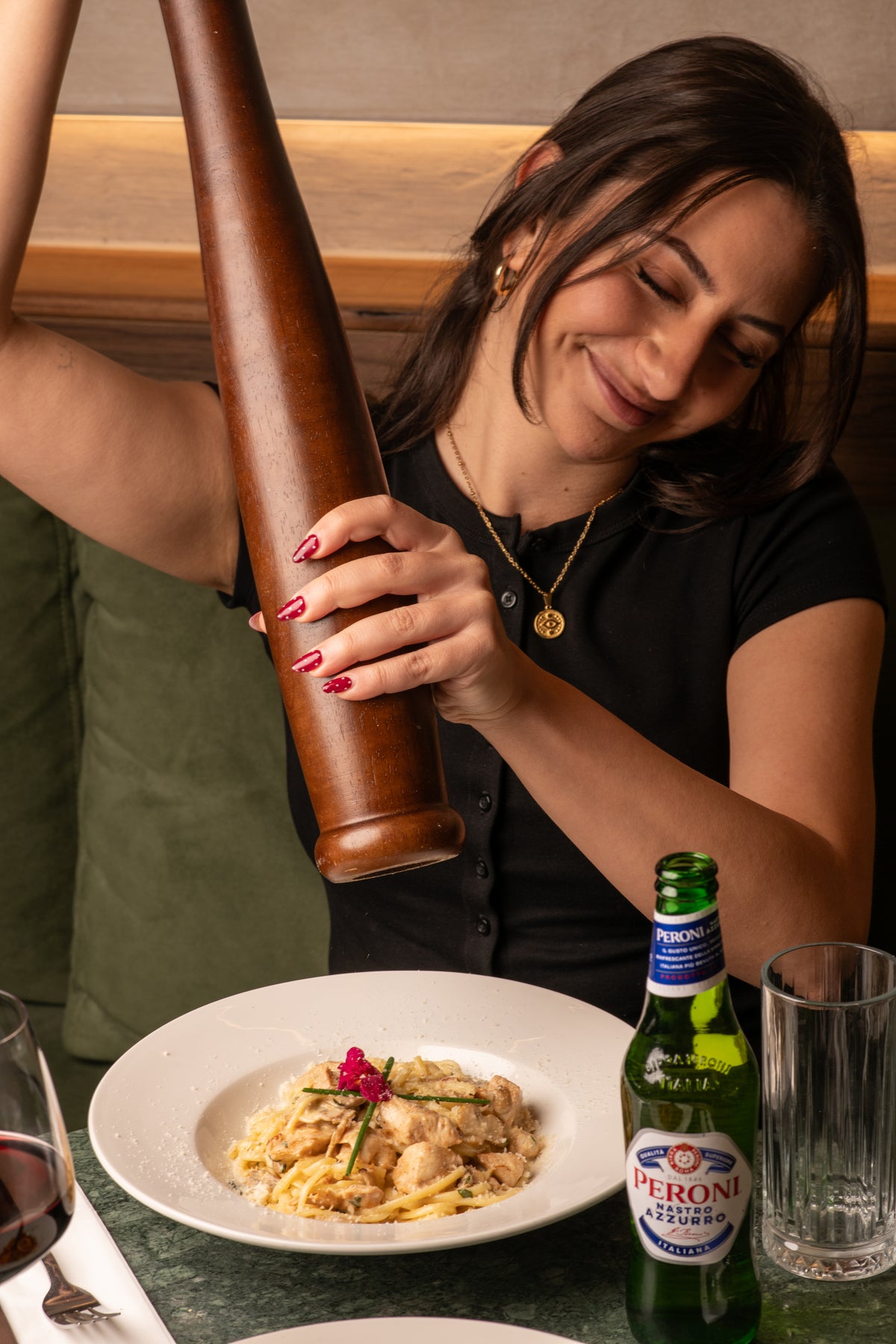
Fanghan, who came with a friend, wrote that The pasta and pizza were both delicious, and the portions were quite generous.
(Fanghan X., Google review) Nasipa found The food was tasty, fresh, and really well prepared.
(Nasipa E., Google review)
For a group
Lasagne classica is also on our group menu for tables of five or more: tender braised beef in a rich ragù, layered with pasta sheets, cheddar and creamy mozzarella, served with a side salad. Our post on group dining at Fiena has the details.
A red to go with it
Ragù and béchamel want a red with soft tannins and plenty of fruit. From our drinks menu: the Montepulciano d'Abruzzo is medium-bodied with plum and red berry, the Cara Amica Sangiovese is ruby red with cherry, red berries and a hint of spice, and the Vitis Nostra Nero d'Avola from Sicily is fuller, with black cherry and hints of chocolate. More ideas in our autumn comfort food post.
“I'd eat here every night if I could”
Fiona, Google review, 2026
Good to know
- When: the main menu runs from midday until close, 22:00 Monday to Saturday and 21:00 on Sunday.
- Booking: tables for up to eight can be booked online, and walk-ins are welcome whenever we have space.
- Allergies: information on the 14 major allergens is available on request. Please speak to your server before you order.
- Address: 4 Medway Court, Judd St, London WC1H 9QX. Phone 020 4618 6314.
Layer upon layer, from midday. Book a table or walk in at 4 Medway Court, Judd Street.